Institutions · Quantitative research
Invisible incarcerations
Going back to prison, and getting less care. Using national survey data on 23,342 incarcerated people, I found that people who had been in prison before had lower odds of getting medical care there, even after accounting for chronic illness.
- Role
- Independent researcher: question, analysis and poster
- Methods
- Survey-weighted logistic regression, 2016 Survey of Prison Inmates
- Year
- 2024–2025
The question
People in prison depend on staff for every part of their medical care, so a missed appointment can leave an illness untreated, let an infection spread, or end in a death that could have been prevented. Most of the research treats incarceration as a one-time event, so I wanted to look at what happens when someone has been through it before. I set out to answer two questions: are people who have been in prison before less likely to get care, and does disability change that?
How I did it
I used the 2016 Survey of Prison Inmates, which is the most recent national survey of state and federal prisons. After dropping incomplete answers, I had 23,342 people. I ran logistic regression models that controlled for 11 chronic conditions, sentence length, time served and demographics. I also measured prior incarceration two different ways, as a yes-or-no and as a count, because I wanted to make sure the result didn’t hinge on one choice.
The idea behind it comes from Erving Goffman’s concept of looping. In a “total institution” like a prison, people learn from past experience to stop asking for things that might get them in trouble.
What I found
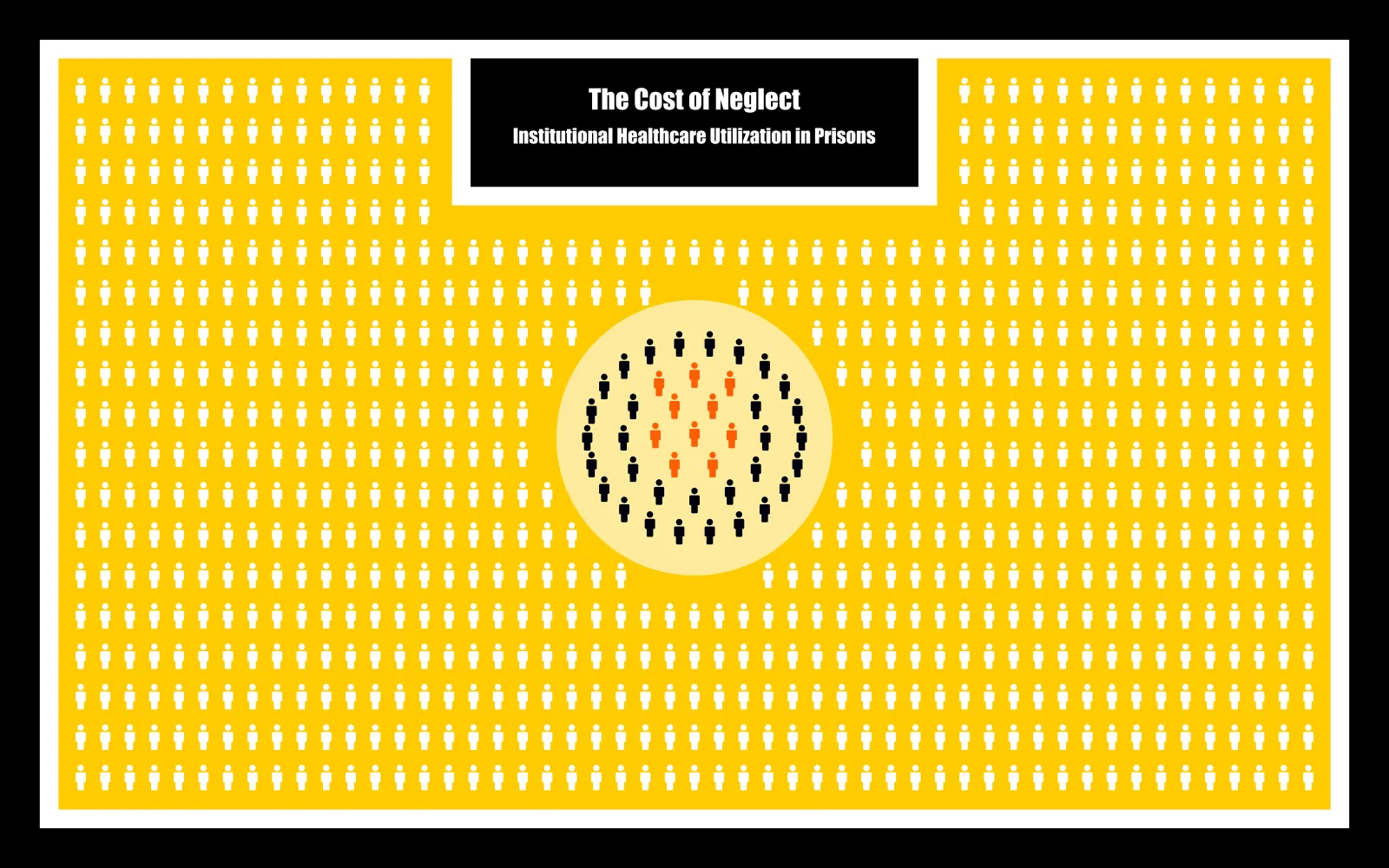
- People who had been in prison before had 17% lower odds of getting any care. That holds after controlling for 11 chronic conditions, disability, time served and demographics (odds ratio 0.83, p < .001), and without the health controls, the gap was 14%. In plain numbers, 82.9% of repeat offenders had seen a provider, compared with 86.8% of first-time offenders.
- Disability helped, but it didn’t close the gap. Disabled people were more likely to get care (89.1% compared with 80.5%), probably because prisons have to screen for disability. Even so, among disabled people, those who had been in prison before got less care (88.1% compared with 92.1%), and the gap was about the same size either way.
- The penalty might build up over multiple stays. More months in prison raised the odds of a visit. In a survey-weighted model, each additional prior incarceration lowered the odds a little, although that estimate fell just short of statistical significance (p = .07). It fits the idea that people learn to stop asking for care, but we can’t establish that with certainty from this data.
The models are logistic regressions on the 23,342 people with complete answers. The model that counts prior incarcerations uses the survey’s weights.
What I’d change
The way a prison schedules care may shape who gets it, because care mostly starts with a sick-call request, and if people do learn not to ask, they can fall through the cracks. I think two changes could help:
- Schedule preventive care automatically, so nobody has to ask.
- Flag prior incarceration in medical records, so staff can see who’s likely to get missed.
Future national surveys could test whether changes like these actually improve access.
Where I presented it
“Invisible Incarcerations: Constricted Care in State and Federal Prisons.” Poster, SOCiable, Department of Sociology, Western Washington University, 2025.